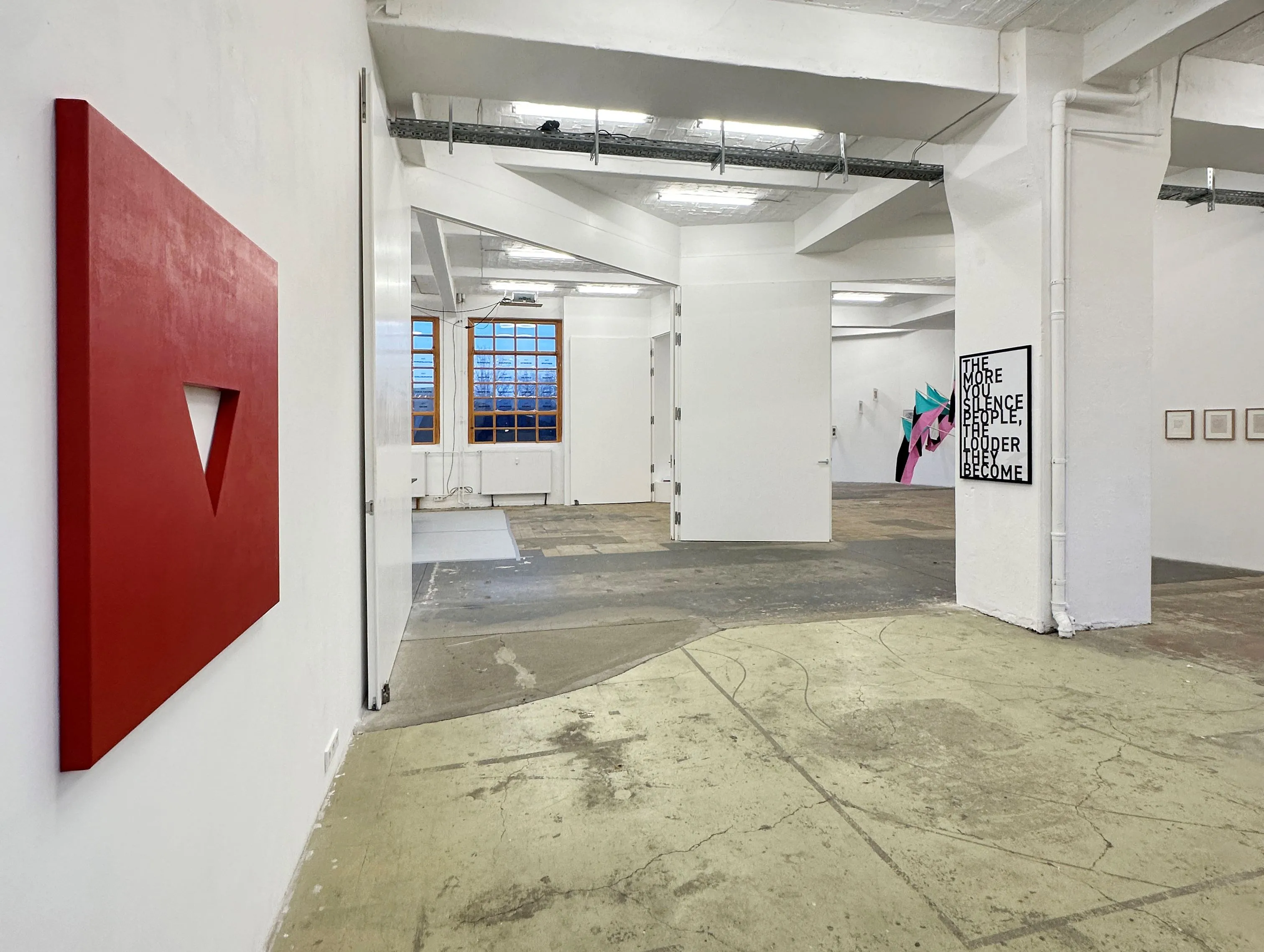
Corpus Delicti
The red triangle carries a damaged itinerary. It has passed through systems of persecution, anti-fascist memory, national liberation, militant propaganda, protest culture, media panic, and legal scrutiny. In the Nazi concentration camp classification system, coloured inverted triangles were used to mark prisoners; red identified political prisoners, including communists, social democrats, trade unionists, and trade union members, among other political opponents.
In Palestinian visual history, the red triangle belongs to the flag’s grammar of Arab revolt, anti-colonial aspiration, and national identity. The Palestinian flag consists of black, white, and green horizontal bands with a red triangle at the hoist; the Palestine Liberation Organisation adopted this flag in 1964.
Since the war in Gaza after 7 October 2023, the downward red triangle has been increasingly read in Germany through another register: as a sign associated with Hamas targeting imagery. In July 2024, Berlin’s parliament voted in favour of restricting the symbol in public and seeking a federal-level prohibition in relation to Hamas contexts.
This painting enters that conflict through subtraction. The triangle is not painted, declared, or possessed; it is removed before it can be seized or criminalised. The cut performs a form of self-censorship, but not as a form of compliance. It stages censorship as an aesthetic trap: by erasing the symbol from its own surface, the painting makes visible the violence that demands its erasure.
The gesture refuses both decorative neutrality and propagandistic certainty. It holds the wound of censorship inside the work itself. The missing triangle becomes the site where state power, public fear, legal interpretation, and media hysteria converge.
The cut is the painting’s refusal to let the symbol be owned by the state, by propaganda, by fear, or by the comfort of a single reading of current or past history.