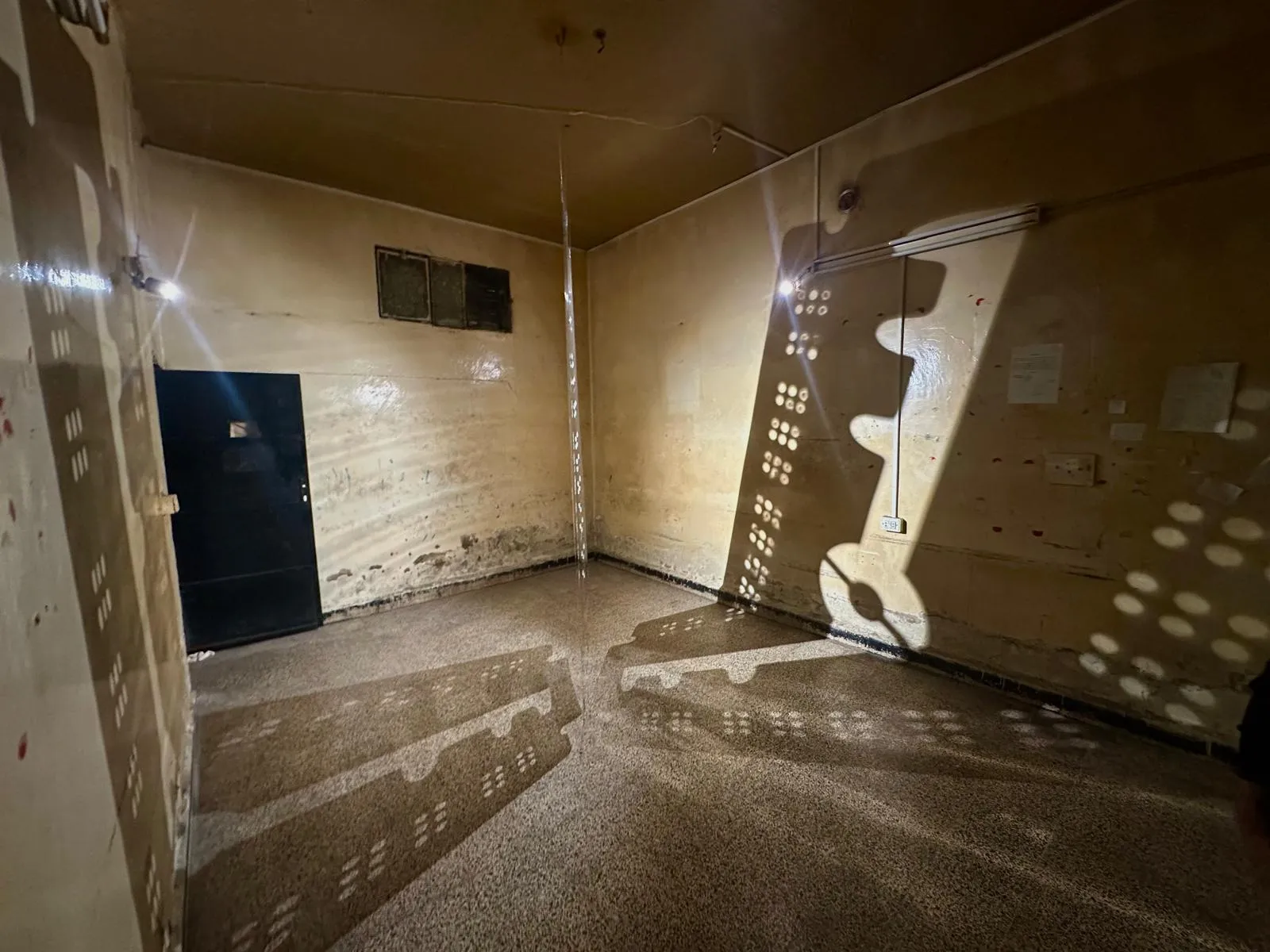
Sharp Refraction
Installed inside a detention cell of the former Prison Narcotics Control Department in Damascus, Sharp Refraction stages a suspended blade as both object and body, caught between life and the possibility of its erasure. Across its cold surface was inscribed the phrase “No one heard me” in Braille, a language predicated on touch rather than sight or voice. It becomes a muted testimony, echoing the cries of those who hovered on the threshold of survival, collapse, or self-harm—legible only to those who approach it through the intimacy of feeling rather than reading.
The perforated key-shaped opening at the centre casts a shifting shadow onto the opposite wall. Depending on the angle of light, the resulting projection can be read as poison, secret, or dam. Here, light does not simply illuminate; it reveals by withholding. It produces a spectral inscription—an unspoken archive of wounds that were never acknowledged, a voice that found no listener.
Within this cell, the blade “bleeds” light and shadow. It does not kill. It reminds us that suicide, in such spaces, is not always a choice but often the final echo of a silence imposed on those whose suffering went unheard.
.webp)