ANTI STORY
ANTI STORY works with the Palestinian flag through a double act of inversion. The flag is first remade with its colours reversed and carried through demonstrations and public spaces across several European countries. It is recognisable through its form, but visually displaced from the image people know.
The action is then photographed, and the photograph itself is inverted. This second reversal restores the flag to its familiar colours, while everything around it—people, streets, buildings, police, sky—turns into a negative.
The work uses this simple visual operation to shift the question of what is normal and what is distorted. The flag does not disappear; it survives through transformation. In the final image, Palestine becomes visually legible again, while the reality surrounding it is rendered strange.
ANTI STORY considers censorship, visibility, and collective recognition. It asks what happens when a symbol must change in order to remain present—and what that transformation reveals about the conditions around it.
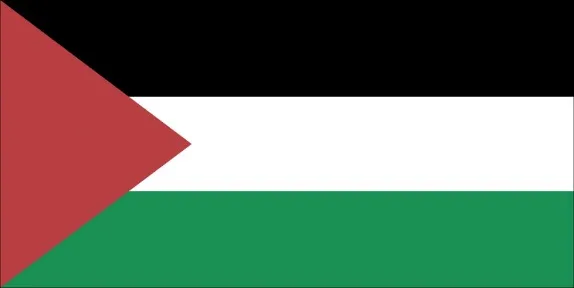
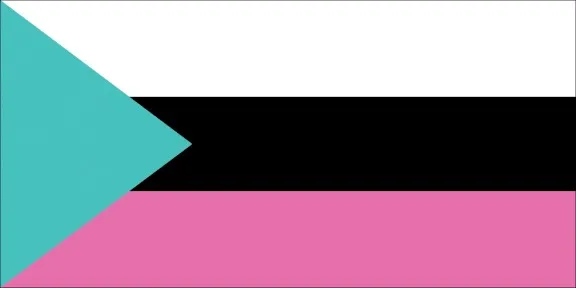
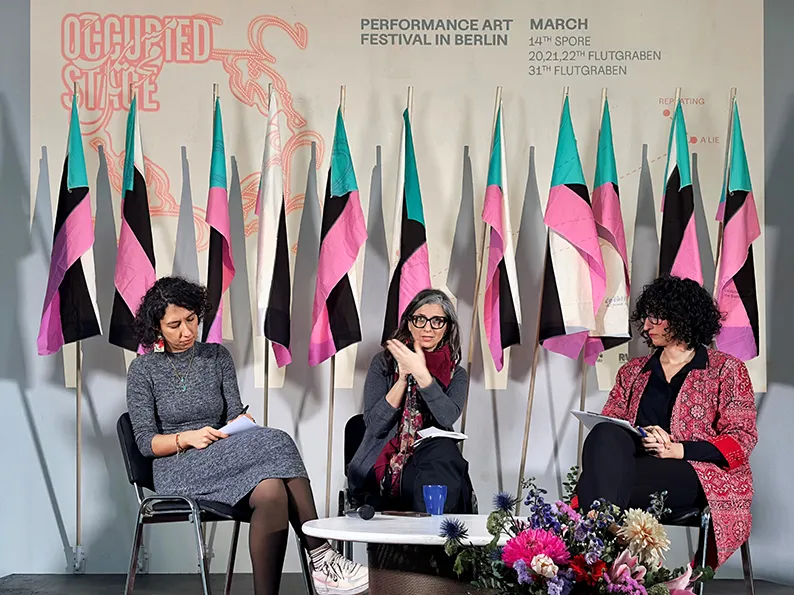
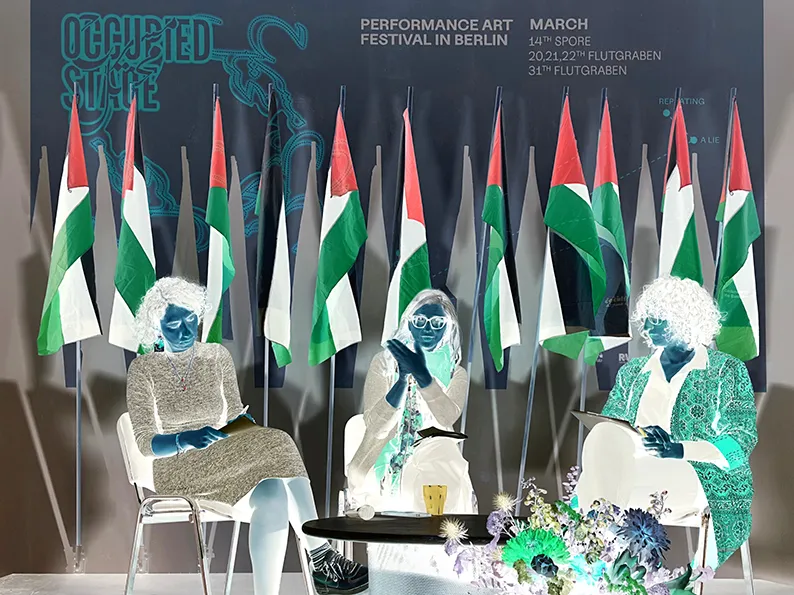
DIY: Flag ratio and color scheme
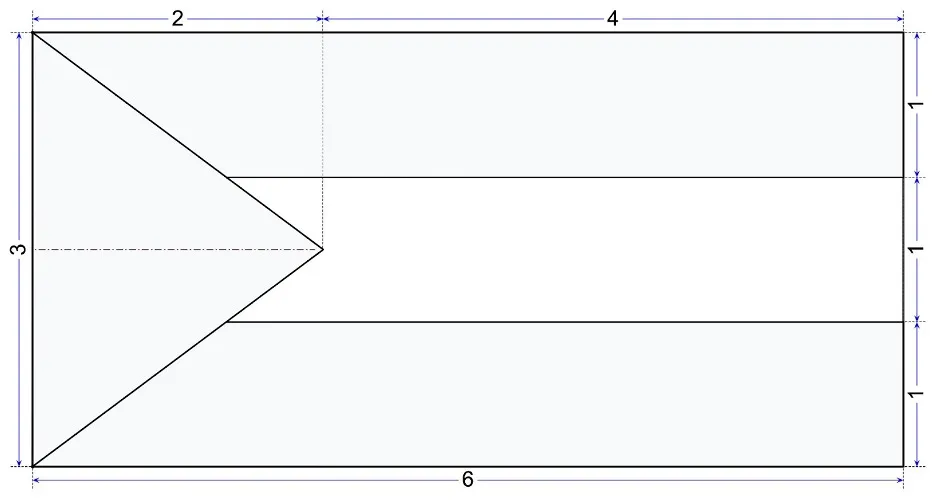
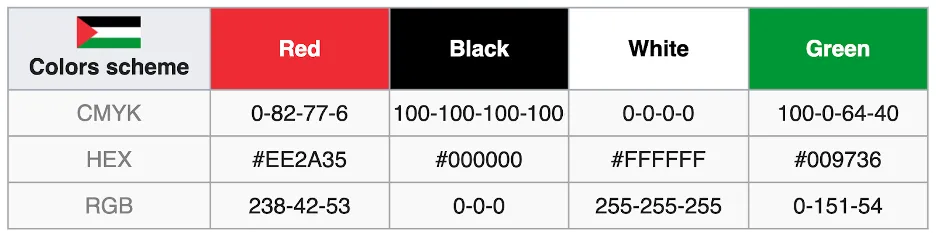
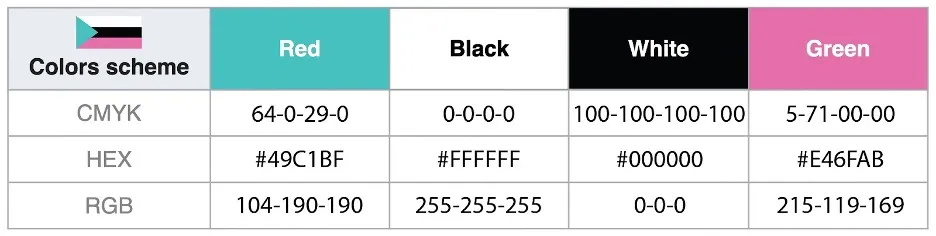
BACKGROUND
The Palestinian Flag: Meaning and History
The Palestinian flag is based on the Flag of the 1916 Arab Revolt, currently adopted by the State of Palestine and used to represent the Palestinian people. The common version concerning the origin of the flag entails that the colours were chosen by the Arab Nationalist ‘Literary Club’ in Istanbul in 1909, based on the words of the thirteenth-century Arab poet Safi a-Din al-Hili:
Ask the high rising spears, of our aspirations
Bring witness the swords, did we lose hope
We are a band, honor halts our souls
Of beginning with harm, those who won’t harm us
White are our deeds, black are our battles,
Green are our fields, red are our swords.
The flag was used by Sharif Hussein by 1917 at the latest and quickly became regarded as the flag of the Arab national movement. On October 18, 1948, the all-Palestine Government adopted the flag of the Arab Revolt, and the Arab League subsequently recognised it as the flag of Palestine. A modified version (changing the order of the stripes) has been used in Palestine at least since the late 1930s and was officially adopted as the flag of the Palestinian people by the Palestine Liberation Organization (PLO) in 1964. On November 15, 1988, the PLO adopted the flag as the flag of the State of Palestine, and then it became widely used. Currently, it is officially the flag of the State of Palestine.
The Palestinian Flag: Censorship and Banning Inside Palestine/Israel
The State of Israel, since its creation in 1948, has tried to ban the Palestinian flag and suppress every demonstration of Palestinian nationalism. The military regime had zero tolerance for any public display of nationalism, and waving the Palestinian flag was a serious offence that could be punished with prison time. In 1967, the State of Israel banned the Palestinian flag in occupied Palestine. Even minors as young as 10 years old were not immune and were occasionally sent to prison for waving the forbidden flag. To circumvent the ban, Palestinians began using watermelon because, when cut open, the fruit bears the national colours of Palestine. Another law in 1980 forbade artwork of "political significance" and banned artwork composed of its four colours. Palestinians were arrested for displaying such artwork. Artist Sliman Mansour told The National in 2021 that Israeli officials shut down an exhibition at 79 Gallery in Ramallah featuring his work and others, including Nabil Anani and Issam Badrl.
In the First Intifada in 1987, Israel intensified its efforts to suppress the flag, sometimes to an absurd and tragic level. Israeli forces violently dispersed demonstrations of thousands in which only one or two flags were being waved. Soldiers climbed electricity poles to take flags down (or sent Palestinians to do so in their place, causing some of them to be electrocuted). On one occasion, an Arab student was arrested for embroidering a shirt with the flag; on another, someone was arrested and accused of incitement after flying a kite with the national colours. After soldiers found a dress in the national colours in a Palestinian woman’s home, they forced her to wear it — and then arrested her for doing so.
Most Israeli mainstream media outlets delegitimised the flag, often by referring to it as the “PLO flag” — a term based on the claim that it was not the flag of the Palestinian nation but only that of the organisation. Though the ban was lifted after the signing of the Oslo Peace Accords in 1993, the Palestinian flags are nonetheless routinely confiscated by the Israeli police. Therefore, the use of the watermelon as a symbol resurged in 2021, following an Israeli court ruling that Palestinian families based in the Sheikh Jarrah neighbourhood in East Jerusalem would be evicted from their homes to make way for settlers.
In 2022, a bill to prohibit Palestinian flags at state-funded institutions passed a preliminary vote but was frozen before its first Knesset reading. In May 2023, +972 Magazine described a separate proposal targeting universities. It would require suspensions of at least 30 days for students displaying flags of an enemy state, a terrorist organisation or the Palestinian Authority; repeat offenders would face expulsion and a five-year restriction on receiving or recognising academic degrees. In January 2023, Minister of National Security Itamar Ben-Gvir announced the intention of the Israeli Government to outlaw the flag.
In June 2023, Zazim, an Arab-Israeli community organisation working together for democracy, equality, and joint, active civic engagement, launched a campaign to protest against the ensuing arrests and confiscation of flags, where the images of watermelons appeared again on 16 taxis operating in Tel Aviv, with the accompanying text reading, “This is not a Palestinian flag.” Zazim director Raluca Ganea wrote, “Our message to the government is clear: we will always find a way to circumvent any absurd ban, and we will not stop fighting for freedom of expression and democracy.”
On May 29, 2023, +972 Magazine reported that 11 proposals restricting displays of the Palestinian flag were awaiting approval in the Knesset.
The Palestinian Flag and Pro-Palestinian Protests: Criminalisation, Oppression, Censorship and Banning Outside Palestine/Israel
In October 2023, national and local governments in major European countries blocked pro-Palestinian protests and detained hundreds of protesters, citing an overriding interest in public order and safety. Instances of police brutality against demonstrators have been reported in major European cities where riot police were deployed for consecutive days during public outrage over Israel's actions in Gaza. Additionally, events that feature groups critical of the Israeli state have been cancelled, such as the Frankfurt Book Fair's event honouring Palestinian writer Adania Shibli for her book "A Minor Detail."
In October 2023, Germany witnessed a clampdown and criminalisation of Palestinians and those wishing to voice opposition to Israel's government actions. Demonstrators reported racial profiling by police, with targeted arrests and detainment of individuals who appear to be non-white or of Palestinian descent. Before October 7, 2023, Berlin authorities had banned events commemorating the 75th anniversary of the Nakba, the "Palestinian catastrophe." In May 2022, they had also banned a vigil organised by Jüdische Stimme in memory of Al Jazeera's journalist Shireen Abu Akleh, who was shot dead by Israeli forces in the occupied West Bank.
Also, the efforts to ban the Palestinian flag expanded beyond Israel's borders. For instance, during the 2016 Eurovision Song Contest, the Palestinian flag was prohibited from being displayed. In an October 10, 2023 letter to police chiefs, the UK’s then Home Secretary, Suella Braverman, said that waving the Palestinian flag could be illegitimate when intended to glorify terrorism, and urged police action where harassment was identified. In October 2023, Berlin authorities also authorised schools to prohibit Palestinian flags, pro-Palestinian speech, and the Palestinian keffiyeh scarf.
For European countries, specifically Germany, to silence this discourse is deeply troubling, both constitutionally and democratically. Such actions indicate a regression to behaviours that the nation has strenuously endeavoured to put behind it.
REFERENCES
www.mofa.pna.ps/thepalestinianflag
www.972mag.com/palestinian-flag-ban-history-israelis
www.time.com/watermelon-palestinian-symbol-solidarity
www.washingtonpost.com/palestine-protest-ban-france-germany
www.aljazeera.com/germany-bans-vigil
www.aljazeera.com/complete-censorship-germanys
www.en.wikipedia.org/wiki/Flag_of_Palestine