Existential Disintegration and the Mirror of the Self
Khaled Barakeh occupies a distinctive and prominent position within the constellation of the young postmodern visual arts movement that has emerged in recent years from the grey space in which the official frameworks of committed art have collapsed. The artists belonging to this youthful constellation can be counted on the fingers of one hand, and none is more than a quarter of a century old.
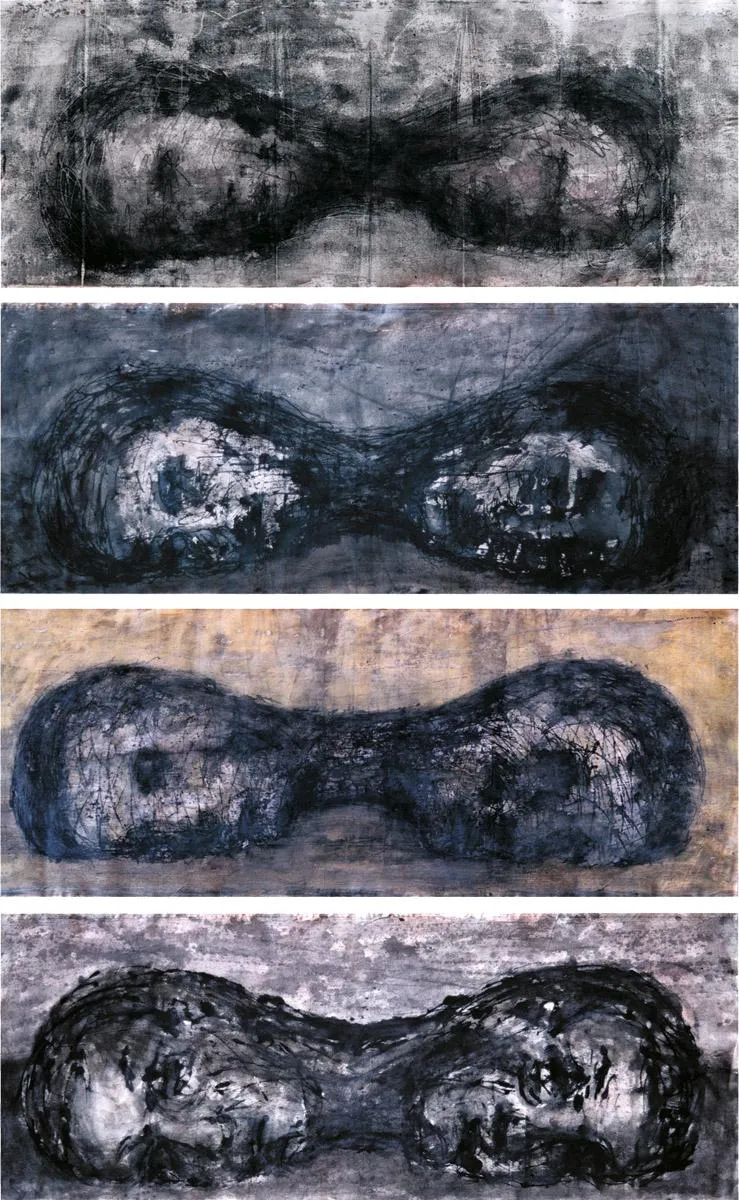
Our young artist’s work is marked by an acute sense of alienation: the “body–ego” and the “head–ego”, veiled by the bitterness of a world at dusk—withdrawn into frustrated isolation. This body, or a fragment of it, such as a foot or a doubled head, reclines within an intensely tragic field. Its form assumes an anatomy in crisis: splintered, fragmented, and severed from the whole.
As his analytical lens draws closer to this spectral structure, its organic particles appear fused with the atoms of the universe. The existential condition of this fragmentation continues until form approaches nothingness and the human figure almost loses its semiotic relationship to human anatomy.
The body laid out in eternity resembles a decomposing mummy. It suffers death and extinction repeatedly: first through microscopic, atomic, cellular, and organic analysis and fragmentation, enacted through the “sadomasochistic” procedures of scraping, hatching, gouging, and incising; and again through its monumental presence, enlarged to a colossal scale within an infinite cosmic void.
Its reunited fragments are shrouded in a pale light, austere in colour yet rich in textures, tissues, and graphic surface treatments. Barakeh seeks to capture a luminous instant that portends danger, like the sudden flash of passing lightning. He pushes his destructive, almost suicidal experiments until the figure of the ego melts and dissolves into the nebula of matter, extracting the body’s sensory topography by moving from its condensed signs towards its deeply buried genetic matrix.
The tragic force of the expression is ignited by this oscillation between connection and separation, rupture and adhesion. It passes through the sensibility of L’Informel—Art Informel—where the successive executions of form approach the limits of annihilation in light and fire.
I am reminded here of the doubled head within one of Barakeh’s serial sequences, a motif to which he repeatedly returns: a head evoking the twinned form of a congenital anomaly.
Perhaps his work occupies a liminal passage between the traditions of a local expressionist heritage, which flourished during the 1960s and 1970s, and the sensibility generated by Neo-Expressionism in European studios today. This sensibility stands against the dead end reached by the various branches of geometric abstraction, including Minimalism.
Khaled’s talent extends beyond his capacity to draw, paint, and destroy. It lies equally in his intellectual communication and the intensity of his thought. He carries painting from the heritage of bearing witness to place towards a universal testimony to time—one bound to the fate of the planet and inseparable from the maps of contemporary alienation and globalisation.
Paris, 2006
أسعد عرابي
التفسّخ الوجودي ومرآة الذات
يحتل خالد بركة موقعه البارز والمتميز ضمن كوكبة الحركة التشكيلية الشابة “لما بعد الحداثة”. هي التي إلتمعت في السنوات الأخيرة داخل المساحة الرمادية التي تهافتت فيها الأطر الرسمية للتشكيل الملتزم. لايتجاوز عدد فناني هذه الثريا اليافعة أصابع اليد، ولا تتجاوز أعمارهم الربع قرن.
يتميز فناننا الشاب بحدة إغترابية: “الجسد-الأنا” و”الرأس-الأنا”، المقنّع بمرارة غروب العالم وإنكفاؤه وعزلته الإحباطية. يستلقي هذا الجسد أو جزء منه (مثل القدم أو الرأس المتضاعف) في حيّز تراجيدي محتدم، تتلبّس هيئته تشريحاً مأزوماً مشظّى منسلخ عن الكل، وعندما يتدانى مجهره التحليلي من هذه البنية الشبحيّة تتبّدى ذراته العضوية الملتحمة مع ذرية الكون، وتستمر وجودية هذا التفتت حتى يقارب الشكل العدم، وتكاد تفقد الهيئة البشرية “سيمولوجية” علاقتها مع التشريح الإنساني.
تقارب هيئة الجسد المسجى في الأبدية المومياء المتفسّخة. هي التي تعاني من الموت والإندثار مرّات متعاقبة، مرّة بالتّحليل والتّفتيت المجهري الذّري الخلوي العضوي (المعتمد على وسائط الحك والتهشير والقلع والتّحزيز “السادومازوشي”)، ومّرة بإيحاءها “النصبي” المتعملق في فراغ فلكي لانهائي.
تتلفّح أشلاؤه المتوحّدة بإضاءة شاحبة زاهدة في اللون، خصبة الملامس والأنسجة وأداءات السطح “الغرافيكي”. ساعيا ًإلى إقتناص لحظة ضوئية تنذر بالخطر، كما هو إلتماع أشعة البرق المارق، ممعناّ في إختباراته التدميرية الإنتحارية حتى تسيح هيئة “الأنا” وتتماهى في سديم المادة، مستخرجاً التضاريس الحسية للجسد من خلال العبور من إشاراته المختزلة إلى مشيمته الجينية الغائرة.
تتأجّج “تراجيدية” التعبير من هذا التراوح بين الإتصال والإنفصال، الإنفصام والإلتصاق، معرجاً على حساسية التيار “اللاشكلي” التي تلامس فيها إعدامات الشكل حدود “الفناء” في النور والنار. يحضرني في هذا المقام ذلك الرأس المزدوج ضمن متتاليته المتسلسلة التي يراجع موضوعها أكثر من مرة: رأس يستلهم توأمياً التوالد الخلقي المشوّه.
لعلّه البرزخ المتوسّط بين تقاليد التراث التّعبيري المحلّي (الذي ازدهر في الستينات والسبعينات), و بين الحساسيّة المتناسلة عن “التعبيرية المحدثة” في المحترفات الأوروبيّة اليوم. هي التي تتعارض مع الطريق المسدود الذي وصلته فروع التجريد الهندسية بما فيها “المنماليّة”.
تتجاوز موهبة خالد القدرة على الرسم والتلوين والتدمير إلى التواصل الفكري والتوقّد الذهني, هو الذي ينقل لوحته من تراث شهادة المكان إلى شهادة الزمان الشموليّة, هي المرتبطة بمصائر الكوكب, وهي التي لاتعرف معنى للعزلة عن خرائط الإغتراب العالمي والعولمي اليوم.
باريس ٢٠٠٦